They just keep reinventing trains except shittier.
What if we made the train wide and flat, gave it armor plating, bolted a pair of claws on the front, and let it run sideways?

Crustation
why would an individual car “train” that can go anywhere (eg. train tracks on all roads for self driving cars) be shitter than a train that has limited availability and is extremely restrictive in where it can go?
Because you have to pay a good chunk of a year’s salary for one, store it around your house somewhere, and then when you finally do get to use it, there are a million other people with the same idea and you have to compete just for space in which to use it.
And that’s before you get to all the maintenance the government has to spend on the paths (and make you pay tax for all that). Oh, and it’s incredibly dangerous, so dangerous that it’s one of the leading causes of death in the US.
We are talking about an equivalent ‘pod/train car’, not a car but I’ll bite anyway
Have you ever been on a train? It sucks, a bus 10000% more, buses fuckin suck so much, I’m sorry for you to hear this in the echo chamber which features ‘fuck cars’.
Like I said, trains and buses have 2 big negatives:
limited availability and is extremely restrictive in where it can go
Trains especially so, my local train would be a 20-30 minute walk away and it goes far south and to the city, if i don’t want to go to either of those I’m in for a 5 hour marathon of a trip at best
But we should invest more in trains you might be saying, and again the question goes back to, why would a train be better than a pod/car that can roll around on train tracks
This whole thread took the original meaning and warped it into a circle jerk about trains which is not what the OP was saying
Sure badly built or unprioritized public transit infrastructure might suck, but busses and trains sure are amazing when prioritised, built correctly.
Many European cities combine well functioning train, bus and cycle infrastructure, which together makes it possible to go anywhere at any time for cheap.
I think it really just comes down to prioritizing to develop the infrastructure (costs money and requires political will to move away from car based infrastructure).
Also I don’t think a pod system would solve any of the problems of either cars or trains/busses and would be much more expensive…
can you name all these European cities combining well functioning train, bus and cycle infrastructure outside of the netherlands? (where the average person/household does not have a car as they don’t need it)
Have you ever been on a train? It sucks, a bus 10000% more, buses fuckin suck so much
Skill issue. Japan, Korea, China all have extremely comfortable and efficient trains. Trains can be quite nice if the government is interested in having good trains instead of making infinitely dollars for the shareholders while spending nothing on maintaince and charging as much as possible.
Thanks for mentioning Japan and Korea
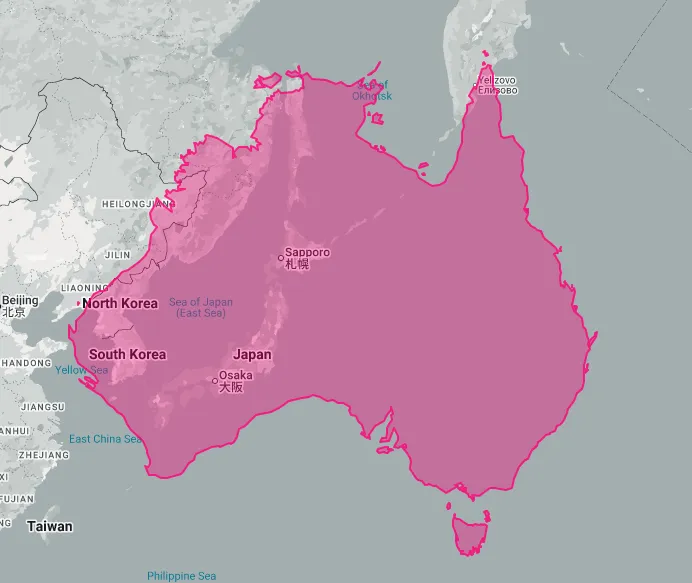
https://files.ikt.id.au/y0q8ls.webp
Japan, South Korea and North Korea would all fit into a space the size of our second smallest state Victoria but that state has a population of 8 million, the combined Korea’s and Japan would be 200 million
Speaking of large population sizes:
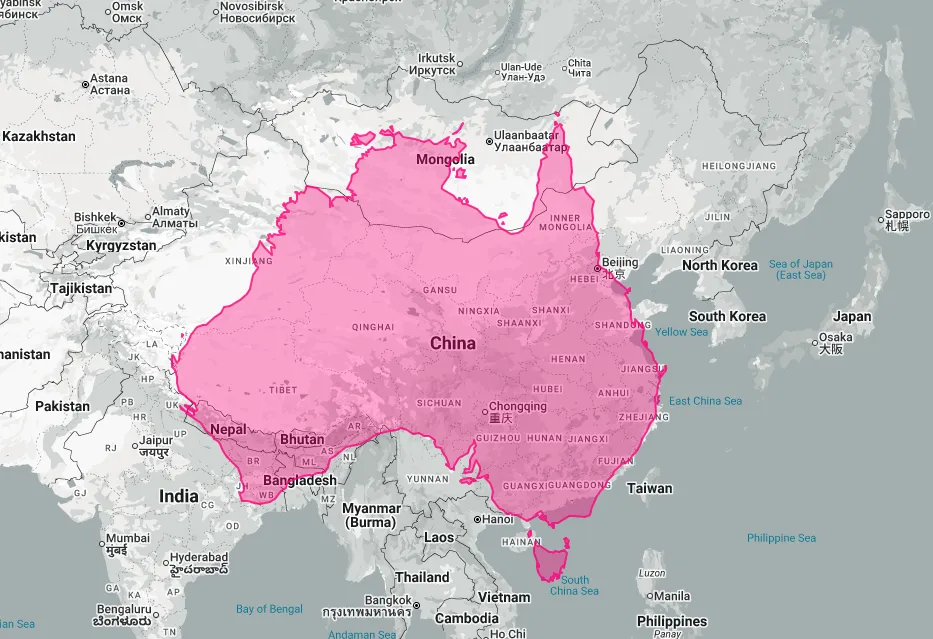
We are nearly as big as China but with 1.4 billion, if you took their desert which has fuck all trains and transposed that onto Australia we’re actually pretty close in terms of trains and public transport
But regardless:
One in Four Japanese Households Do Not Own A Car
Which leaves 3 in 4 who do own a car, so much for skill issue right :)
I almost thought you were American given your “rail doesn’t work, look how big our country is” BS argument. I guess it works for Australia too, though. Funnily enough your own map shows how Australia is actually perfectly siuted for extensive rail infrastructure connecting most of the metropolitan regions with each other.
Adelade-Melbourne-Sydney-Brisbane covers most of Australia’s population and is a model case for an HSR corridor, certainly also has the population to support one as well. Add to that a Dutch style multimodal urban model and Australia could be on par with the rest of the developed world infrastructure wise. Perth and Darwin are self contained urban islands anyway, too far for attractive rail but also road connection
if you took their desert which has fuck all trains
They run hundreds of trains a day between population centers in that desert, I took them to get to Kazakhstan and back.
skill issue
The skill issue is being able to build efficient, comfortable, cheap trains, which Japan has the first 2, but they could be cheaper.
Buses are the worst (actually, pneumatic tyred ‘trams’ are the worst)
Trains are great though.
yeah tbh i was being a bit hyperbolic, i don’t mind my train trip to work despite it being slow af
but it would take an insane public transport network to service south east queensland, until we find an infinite money glitch it’s only going to be used for a minimum viable amount of very popular trips, eg between brisbane and the gold coast and soon the sunshine coast
but for example if you want to go to crows nest from brisbane there will never be a train that goes that way because of low numbers
The only reason cars are good right now is because countries like US and AU went 100% all in on cars. Do you have any idea the astronomical cost of public roads and car infrastructure? Imagine if we invested the same amount into a really really good train and tram system. Or, alternatively, imagine if we underfunded roads the same way we do public transport.
The only reason cars are good right now is because countries like US and AU went 100% all in on cars
Not 100%, Melbourne kept its trams around and Victoria still has massive car use
We’re just a huge massive low density country so it’s hard to compare to inner western europe
Yes you’re right, I was being hyperbolic. We’re 90% mostly-in on cars
Melbourne’s trams are terrible because cars are given priority even though having much lower capacity. The “low density” argument is meaningless. Most people live in metropolitan regions and they are as well suited for transit as you build it. Turns out, Australia went all in on car only design on new projects. Surprisingly that makes anything other than cars unattractive.
Works pretty well in Europe. They have a huge train system that goes all over the place.
No it doesn’t
Notably, as shown in Figure 1, passenger cars accounted for 73.0% of passenger-km travelled in the EU-27 in 2022 – the largest of any mode of transport
Public transport activity reached around 995 billion passenger-km in the EU-27 in 2019. This represents a 2.2 percentage points reduction in the share of these modes in the total transport activity compared with 1995. This share reached approximately 16.6% in 2019
Cars > Trains
It’s always trains
“Trains, but without the tracks.”
Trains but without having to sit next to people who aren’t your staff.
Australia has entered the chat
What if we had trains, but bigger?
I’m not making a joke, I honestly think making the track a little wider would be a great innovation.
Well it would require wider curves and be incompatible with existing rolling stock.
Obligatory XKCD.
“I have invented a computer that can handle the complexities of a dense, conflicting network of streets prone to collisions with on-traffic. It just needs a specialized road that is less dense and doesn’t have conflicts with other on-traffic.”
“Is your program just ‘Accelerator-turn-on()’?”
“How did you get that information?? Who broke NDA!?”There’s more to it than that, you also have to decelerate now and then
I have to go, I’ve said too much
Just slap a
-on theaccelerate()
Techbros really going beyond to invent shittier less efficient trains.
They’re not really trying to do anything. They’re trying to get venture capital money. The more impressive and revolutionary the blender render is, the more likely they are to get some fat, unsecured VC money. Then they’ll cash out and move on to the next thing.
It’s a grift. They just need the poors to be excited about their bullshit to convince someone with money that there’s money to be made with their bullshit.
They insist on recreating everything in modern society from first principles, rather than just learning from the past.
They can’t just accept that X is a bad idea, and we know this because we fucking tried it several times. That’s why we do Y, even though it might seem counterintuitive. They just need to go through it themselves, and fuck the people whose lives are ruined in the process. Collateral damage. To learn something that we already fucking know and have been telling them
This is what I bring up with a coworker all the time as to why education is so important. Knowing the mistakes and pitfalls from the road to get to where we are right now is important so you don’t waste time trying to reinvent the wheel. Also it helps when you look at a problem and think “The solution is SO obvious! Just X!”. After education you tend to think “There’s probably a good reason we don’t ‘Just X!’, I just am unaware of it.”. Though you srill need to do your due diligence and research.
That said, there are always ideas that weren’t feasible at the time, or some breakthrough that they never thought of in the past that could make something relevant.
Several years back there was a startup?, I think, that tried to revolutionize rail traffic with autonomous wagons that intelligently form wagontracks with decentralized coordination. The question, how they would coordinate between all the local rulings and different track designs, was answered with ‘There is data for that to use and everyone will restructure for their glorious idea’ - safe to say they didn’t went viral
There have been a few. The best idea was a rail that went down every road. You could call train pods like an Uber to go anywhere. Computers could regulate everything. Anyone could use them. Cars are dumb.
I mean… I’d totally rock a personal mini train that left when I wanted and rode on a track.
That basically how trains work in Copenhagen. They use small, automated trains that come every couple of minutes. You just wander to the station and get on, no planning or anything.
And also has a station at my house.
Nah, that would make it hella dangerous to just be a person existing in that space. Much safer to use trains to get to a city and then travel in the city by personal conveyance, like a bike or something. Imagine how awful life would be if we gave all that space to train tracks just for individual use. It would be an isolated, lonely nightmare. Not to mention super expensive too. Train engines, no matter how small, are not cheap to own or operate.
I’m going to want something with a roof, windows, and climate control, though – for when the weather is bad.
I bicycle plenty, but there are definitely times when I’d rather not and it’s miserable.
I am currently at the tail end of a 3 week trip from Amsterdam to Lisbon, all via train. It is fucking awesome. Not to mention that as a tourist you can use the public transportation in various cities for free. Europe has it figured out.
Man, I’m surprised to hear that. International travel is infamously shit, that’s part of why so many Europeans fly. The trains themselves are fine, but there’s a mishmash of standards, electrical systems, booking systems, etc, and every country just wants to engage in protectionism and refuses to harmonize with others. Trying to book travel through multiple countries is usually seen as a bigger headache than it’s worth, not to mention more costly, than flying which is just backwards in terms of incentives.
Maybe if you’re getting one of the tourist Eurrail pass thingies it isn’t so bad, but for regular international use (aside from just going to one country over, so just one journey) Europe really needs to standardize its rail travel much, much more.
I used Interrail and I booked everything through that. Easy as pie.
Glad to hear you had a good experience overall!
Tracks
The only way to solve the self driving cat issue is to ban all human drivers from the road.
So, if some techbro wants self driving cars, just give everybody one. All electric of course.
The only way to solve the self driving cat issue is to ban all human drivers from the road.
…and cyclists, and pedestrians, and farm tractors, and horses, and wagons, and stray pets, and wildlife, and…
Cyclists and pedestrians shouldn’t be on the road.
Unless you’re in the US (my condolences) you have a footpath/sidewalk/pavement for walking.
Bikes should (but rarely do) have their own physically seperated infrastructure, so they’re not getting hit by cars/busses/trucks/etc and not hitting pedestrians.
Cyclists can go on the road just fine, as long as the road is built and regulated for more than just cars
No, bikes should never be on Roads.
Streets, yes, Roads, no.
Eh, it depends. Faster bike traffic shouldn’t really be in such close proximity to pedestrians. On a lot of city streets, a fast bike is way closer to the speed of a car than to a pedestrian. City centers, especially non arterials, I’d say they should be in the street if there’s no path. I’m not particularly fast at just under 30kph and it’s rare for traffic to be much faster downtown here, especially non arterials I’m often passing them. I think that’s generally too fast to safely ride on a sidewalk, but a safe speed there would make cycling not very practical for me.
Which I can assure, unfortunately, no cycle paths is often the case in my part of eastern/central Europe
Cyclist belong on their bicycle lanes , and those lanes belong besides every road.
Pedestrians belong on walkways, along every road
What is about stray pets and railroads? Horses , dogs, cats?
If we are talking about something so unrealistic and futuristic like autonomous vehicles lvl 5+. We may as well assume that we fixed everything else at that point of time.
Or, we just can take this as what it is. A sarcastic joke
Giving everybody a self-driving car completely defeats the purpose. Human-driven cars spend about 23 hours of each day just sitting around. A car that can drive itself doesn’t need to spend any time being parked - it can provide another ride! Liberally assuming a self-driving car would need to spend a full half of its time (12 hours/day) charging or being serviced, that would still mean that replacing all cars with autonomous vehicles could reduce traffic volume by a theoretical limit of 12× (12 hours/day/vehicle vs. 1 hour/day/vehicle).
Is that realistic, though? A car is already a status toy, what’s to stop conspicuous consumption in the form of buying one’s own self-driving car? Or, say, moving to a cheaper house further from the city, because commute time can now be used as work time? Shared cars won’t work in that scenario.
Also, rush hour is still a thing. There have to be enough UAVs to handle peak demand, and then most of them will be parked somewhere, idle most of the time. Or running errands. Traffic congestion is bad enough now, with average vehicle occupancy of 1.2 people; it’ll be apocalyptic when that number drops below one.
Also, in cities with sky-high housing costs, i guarantee that people will live in self-driving RVs, because road space is “free.”
In short, the only way to realize the benefits of the shared UAV future is to ban private car ownership, and cap the number of UAVs in a city. That sounds a lot like a train, except trains’ enormous capacity offers better service.
I doubt that we’ll be seeing UAVs for personal transport anytime soon. Terrestrial vehicles are significantly easier to manage.
The main thing that will prevent people from purchasing their own AVs will be availability. Waymo and Zoox, for example, are running services, not selling their multi-hundred-thousand-dollar vehicles to the general public. (I’m not bothering to address Tesla as their autonomy stack is an industry joke.)
Elimination of personal vehicles would make public transit more attractive; with the previously foregone conclusion that one must own a vehicle gone, the choice is between a few dollars for transit, or several times more than that for a private vehicle. How many people currently choose to take an Uber or Lyft to and from work?
Also, trains don’t have curbside service.
UAV meaning Unmanned Autonomous Vehicle. (In contrast to rideshare services, like Uber. When they were heavily subsidized, it must be noted, they increased traffic congestion.) Availability of them will increase. The reason that we have an auto-dominated landscape today is that car makers wanted to sell more cars. There’s approximately 0% chance that car makers today will be satisfied selling a limited number of vehicles for ride services, when they could sell vastly more cars to individuals.
UAV already stands for “unmanned aerial vehicle.” Besides, using both “unmanned” and “autonomous” is redundant. Anyway, the standard abbreviation for autonomous vehicles is AV.
Buggy whip salesmen gonna have to deal with it.
I suppose a vehicle that is being driven by remote control is unmanned but not autonomous.
Sure, but an autonomous vehicle is by definition unmanned.
Why would it reduce traffic volume? The cars that are on the road are the ones that are currently in their hour of driving that day, it would more reduce the size of parking lots and parking space allocation, or at least move it to charging hubs away from where people congregate.
it would more reduce the size of parking lots and parking space allocation
Which would in turn affect city design, letting buildings be placed closer together, making it so you don’t have to drive as far, which would then reduce traffic.
I think the reduction would be slight versus the reduction realised by improving the quality of existing human operated public transport like buses and trains. A mass transit system relying on individual automated cars is a tech bro brain fart.
Elimination of personal vehicles would make public transit more attractive; with the previously foregone conclusion that one must own a vehicle gone, the choice is between a few dollars for transit, or several times more than that for a private vehicle. How many people currently choose to take an Uber or Lyft to and from work?
Yeah it would be better still if we we had actual improved public transport systems for carry more people at once rather than automated personal vehicles, even if those automated personal vehicles are shared like taxis. The cost of automation and requirement for removing all other vehicles, pedestrians, cyclists and animals from the roads is immediately removed and the benefits obtained by reducing traffic is immediately realised just by using human driven buses and trains.
Well, one of them is happening faster than the other, so let’s not perfect be the enemy of good.
you’re forgetting here that all people want to commute at the same time between 7am and 9am in the morning. so you can’t just operate 1 vehicle 24 hours around, you need the vehicles for these two hours especially and then some in the afternoon.
Elimination of personal vehicles would make public transit more attractive; with the previously foregone conclusion that one must own a vehicle gone, the choice is between a few dollars for transit, or several times more than that for a private vehicle. How many people currently choose to take an Uber or Lyft to and from work?
Also, it’s certainly not all people, nor all commuters.
Giving everybody a self-driving car completely defeats the purpose.
Not really, battery-electric cars can double as your household battery bank.
It seems a lot cheaper to buy a battery bank than to spend a sizeable fraction of a million dollars for the rest of the AV and the operational costs.
My hope has always been that if self driving cars are successful, almost nobody will own a personal car.
Cars are massively wasteful. Put aside the idea you’re hauling around multiple tonnes of steel and glass frequently to just move one person. Ignore the pollution aspect too. They’re also wasteful because they’re used for maybe 2 hours per day, and the other 22 they just sit somewhere taking up space and getting rusty.
Just think about how many stationary cars you pass when you’re out in the world. Nobody’s getting any use out of them, they’re just sitting there in case they’re needed, meanwhile they’re taking up useful space. There are other potentially expensive things you only use for a short amount of time each day: say, a good kitchen knife. But, most of them are indoors where they’re not exposed to the elements and deteriorating without being used.
In a future with self-driving cars, owning a car could be a luxury that enthusiasts could pay for, if it was worth it to them, but everybody else who needed a car could just rent a car for an hour or two.
I think that is the difference of perspective. Living in Germany, I did my driver’s license with 22, didn’t need it before. I could live without a car.
Yes, many would profit from shared, autonomous cars. But many would profit from public transport here in Germany to, and guess what. They want cars.
I hate this as much as the next dude. But if they really really want them, at least make them electric
if they really really want them, at least make them electric
And very expensive.
And very expensive.
So only the rich can afford them?
Yes
Or make motorcycles more popular ;)
Trains for long haul + autotaxis (or air taxis) for short, low speed rides actually sounds pretty dope.
trains rule
All I know is that the tunnel snakes rule. I don’t know whether a train is technically a tunnel snake or not.
I agree about tunnels snakes. You cannot deny. They just manifested ruling in their default introduction and have not given one reason NOT to rule since. They too, are born from train’s sibling using a term someone made a portmonteau of the subterranian…WAY? Normalize subtrainian.
LOL
Friend, I am acutely aware. We humans haven’t taken very good care of our habitat, and it’s showing. The next years aren’t going to be fun, but perhaps if all humans everywhere can manage to find the will, we can mitigate some damage.
Trains cant take you to specific spots, especially outside the greater urban areas.
When my public transport to work stops being 3-4x longer than simply driving, not to mention the inherent issues of being stuffed into a bus, let me know.
deleted by creator
Trains cant take you to specific spots, especially outside the greater urban areas.
That’s called the “Last mile” problem. Trains and buses aren’t much good for a whole day’s worth of shopping either. Try and haul 2 weeks worth of groceries for a family of 3 on a bus. But trains are great for longer distance travel from one area to another. And buses can be great for a quick one-stop trip to the hardware store. But a cargo e-bike would be better yet for light shopping.
I’m all for banning all motor vehicles in major cities, except emergency units. And leave the daily driving to those of us that live in the middle of nowhere and seldom visit large cities.
Dense public transportation sorta fixes the last mile problem. And buying local fixes the Walmart/carrefour problem. I buy groceries every two or three days, and the grocery shops are always at walking distance from home.
“Sorta fixes” ain’t really a fix. And not everyone has the time or ability to go shopping every two or three days. Nor are grocery stores within walking distance for everyone.
That’s the thing. Car orientation shapes how places look and function, but so does tranist orientation. What you consider a downside is actually driving that. Because transit focuses movement along hubs and spokes, this enables walking oriented infrastructure. And walking oriented stores at transit stops enable fast shopping. You can easily shop even daily when all it takes is maybe 5-10 additional minutes on your way home. In car oriented hypermarkets you can’ even make it to the back of the store in that time.
Thing is, we’ve got cities built for cars. The only thing removing cars does in those cities is make everyone miserable. Fixing that would require tearing those cities down to bedrock and starting over from scratch.
The Netherlands have not torn down their cities to the ground even if their cities were pretty car centric in the late 1960s. Of course If you cry for the failed city highway in Utrecht for example that has been replaced with a gracht and scaled down to a regular street, that transformation is a catastrophe for you.
Cities change over time, if you change them away from being car only, that doesn’t need dramatic sudden changes but can be achieved with gradual changes over time.
Also LA has not torn down or destroyed much of its city, just because it has rebuilt a rail transit backbone again (far from perfect or complete but quite substantial already)
You’re clearly not paying attention. Plenty of cities have successfully switched to more walking-focused infrastructure and it hardly requires tearing them down and starting over from scratch. That’s a bit of an overreaction.
There are also people with mobility limitations.
So what? It depends on the kind of mobility impairment, if rail is suitable. Good rail and transit systems accomodate people in wheel chairs just fine, if you are impaired in other ways and can’t use a wheel chair you still got plenty of options. The Netherlands show that transit oriented cities are actually better and safer for people with limited mobility.
Last mile is solved by small folding bikes like the Brompton with ease. Also, 2 weeks worth of groceries is just so many groceries. You don’t need that many at once, lol
That line of argumentation can only be made by someone who can only imagine a car centric way of life. Why would you even do a two week shopping if a well sorted super market is just around the corner or next to your final transit stop?
That said, it is not much of a deal to do larger shopping. You can put a lot in a shopping trolley, also heavy stuff and move it with ease, to your very kitchen. The thing is, if you are shopping that much so infrequently you have to live orimarily from non-fresh food, or old food. Why would you want that?.
You assume large and well stocked grocery stores exist everywhere. That is most assuredly not the case in every city, town, or hamlet. And as for large amounts of shopping, you have never fed a teenage boy or girl have you. They can eat up their weight in groceries every week. And yes, fresh arugula is not readily available in many places. So that’s great for you. But again, don’t assume other people get to have the same choices you do.
And to be a dick about it too, really shows how disconnected from others reality some folks are.
I am talking about urban and suburban context. Not rural scenarios where transit cannot be a full alternative.
What you miss is that the way your city/suburb looks like is a direct function of your urban planning. Transit itself fosters the creation of super markets at its stops. Which is why you will usually find those at stops in transit oriented places. As their main customers are transit users they also cater to their preferences and are designed differently from car oriented stores. Usually they allow for much faster shopping while having a focused but complete sortiment (not just chips, sweets and beer)
You’d be surprised, there are plenty of young families in Vienna in the new pedestrian oriented quarters, many if not most don’t even own a car. Somehow you can manage just fine that way. It is one of those myths that you need a car with young ones, if you live in a transit oriented place or suffer for it. If need be just get a shopping trolley, folding handcart or freight bike.
PS: It is nice to see how you assume fresh bread, vegetable, meat etc are necessarily a luxury. I assume that idea also comes from the context of a car centric society.
is nice to see how you assume fresh bread, vegetable, meat etc are necessarily a luxury. I assume that idea also comes from the context of a car centric society.
cries in USA
Spoken like an upper middle class person. And yes, fresh tomatoes and lettuce can be a luxury even in a dense city. Food deserts exist even there. Not everyone lives in Vienna or the Netherlands. And ordinary people do NOT get to choose the urban planning they can afford live in. Almost all of it was decided 100+ years ago. And is nearly impossible to change now. Unless you want to move large numbers of the population out of an area to demolish and rebuild that much new infrastructure, a thing that often gets called “gentrification”. And what of the poor people who can’t afford to live where you do and how you do? They very often live the farthest away from all those things you take for granted.
Spoken like an upper middle class person.
In fairness, it’s often false thrift to move to an area you need a car with the hopes of saving money on rent… that all ends up going into the car. I hear you as someone born into poverty in a car centric place that this often isn’t a choice, that’s fair, but all else being equal my experience that needing to maintain a car was a constant albatross around our neck as a family. Once I moved to an area with good transit and didn’t bother with a car, I could save way, way more money even considering higher rent…
Like I said, your opinion seems to be formed by a car oriented society and you appear to struggle to imagine an alternative. If you need to watch your finances you can find all those fresh produces at urban discounters in transit oriented cities. Buying those without the need for a car is actually less costly than having a car and buying the cheapest worst kind of food.
That is the thing transit oriented cities generally enable that. I m well aware that not every city is transit oriented. I am not saying people living in these places have a choice. I am saying urban planers have a choice to change how the cities look for the next generation(s). You mentioned the Netherlands, they are a great example for that. 2 generations ago they were very car oriented following the US lead. Not 100 years ago, 50 years ago.
I am not saying people living in these places have a choice. I am saying urban planers have a choice to change how the cities look for the next generation(s).
Rampant fascism is on the rise, here and abroad. We can’t even get US citizens to recognize Mamdami is center, at best, or as I’m discussing elsewhere, how to even get our compatriots online not to accuse us of being trolls, and in 3D not to view us as enemy (see also POTUS reverting to full McCarthyite “Godless communists” red scare tactics on Truth Social).
It seems like you’re arguing that a better way of doing things is hard, therefore not worth doing, or that a century ago was the cutoff for deciding how we do transportation.
The way our stuff is laid out makes it difficult to live without a car. That doesn’t make the car a necessity in the abstract when that layout and design is often the direct product of designing around cars in the first place. It makes the car a necessity in the specific system we have for many people.
“We can’t do things differently because then it’s harder to do things exactly the same” is a weak argument.Spoken like an upper middle class person
Are you actually using your perception of someone else’s economic class as an argument? When you’re arguing in defense of car based suburban sprawl and buying groceries by the carload?
Food deserts.
not to mention the inherent issues of being stuffed into a bus, let me know.
???