alt text
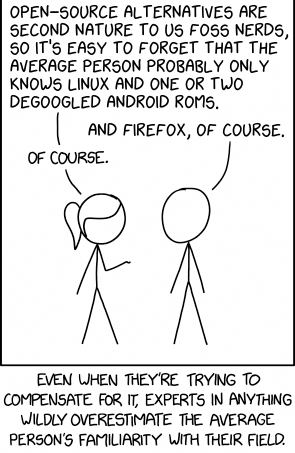
An edit of xkcd 2501, “Average Familiarity”:
[Ponytail and Cueball are talking. Ponytail has her hand raised, palm up, towards Cueball.]
Ponytail: Open-source alternatives are second nature to us foss nerds, so it’s easy to forget that the average person probably only knows Linux and one or two degoogled Android ROMs.
Cueball: And Firefox, of course.
Ponytail: Of course.
[Caption below the panel]
Even when they’re trying to compensate for it, experts in anything wildly overestimate the average person’s familiarity with their field.
partly inspired by the replies to this post but i see this kind of thing all the time (shoutout to the person who once genuinely asked “who still uses google these days?”)
made with this neat tool
That’s why I find posts here like “Fast-MBysoon is getting a major update!” funny. The amount of times they just assume you know what it is and then you go into the comments and the only one is “care to say what Fast-MBysoon is?” So many FOSS users just assume everyone knows about their Microkernel-Based YAML Synchronisation Object Notifier project is.
The Fast-MBysoon Project
Fast-MBysoon (Microkernel-Based YAML Synchronisation Object Notifier) is an ultra-low-latency middleware layer designed for distributed industrial robotics.
In high-stakes environments—like automated assembly lines or autonomous warehouse swarms—different hardware modules need to share state updates without the overhead of a bloated OS. Fast-MBysoon treats system configurations and sensor states as YAML-defined Synchronization Objects.
By operating on a microkernel architecture, it ensures that when one robot arm’s “Object” (e.g.,
current_velocity) changes, every other node in the cluster is notified with nanosecond precision, bypassing traditional networking stacks.Core Architecture
The system relies on a “Pub-Sub” model where the microkernel acts as a high-speed traffic controller for YAML-serialized state blobs.
Abstract Pseudo-Code
The following represents the high-level logic of the Fast-MBysoon kernel loop and a typical client interaction.
1. The Microkernel Dispatcher
This runs in the privileged ring of the microkernel, managing memory gates.
# Kernel Space: The "MBysoon" Heartbeat
function KERNEL_SYNC_DISPATCHER():
    while true:
        # Wait for a hardware interrupt from a Node
        event = WAIT_FOR_INTERRUPT()

        if event.type == "OBJECT_UPDATE":
            # Identify the YAML object being changed
            target_obj = Registry.lookup(event.object_id)

            # Validate the new YAML schema against the blueprint
            if VALIDATE_SCHEMA(event.payload, target_obj.blueprint):
                # Atomic swap of the object in shared memory
                ATOMIC_COMMIT(target_obj.memory_address, event.payload)

                # Notify all subscribers via direct kernel signal
                for subscriber in target_obj.subscribers:
                    SIGNAL_THREAD(subscriber.thread_id, "STATE_CHANGED")
2. The Client-Side Implementation
This is how a robotic “Gripper” module would interact with the “Arm” module’s state.
# User Space: Robotic Gripper Node
import MBysoon_Client as mb

def ON_ARM_MOVE(new_state_yaml):
    # Logic to adjust gripper pressure based on arm speed
    speed = new_state_yaml['velocity']['vector_sum']
    if speed > 5.0:
        ACTUATE_GRIP_STRENGTH("HIGH")

# Initialization
# 1. Map the remote "Arm_Status" object to local memory
arm_status = mb.subscribe("industrial_cluster/arm_01/status.yaml")

# 2. Assign the callback for notifications
arm_status.on_update(ON_ARM_MOVE)

# 3. Execution loop
while system_running:
    # The MBysoon kernel handles the heavy lifting
    # This thread sleeps until the Notifier wakes it up
    mb.AWAIT_NOTIFICATION()
Why “YAML”?
While binary formats are faster, Fast-MBysoon uses a pre-compiled “YAML-Binary” hybrid. This allows engineers to write human-readable configurations for complex robotic behaviors that are “baked” into the microkernel at boot time, combining developer-friendly syntax with machine-speed execution.