Artificial-intelligence systems such as large language models (LLMs) can exhibit behaviour that seems strikingly intelligent. This has led many people, including some experts, to wonder whether these systems could have some form of consciousness — the capacity for subjective experience. However, we think that existing AI systems are not conscious, and that, along current trajectories of development, they are not likely to become conscious. Greater clarity about whether AI could become consciousness will be crucial as society grapples with the challenges posed by this increasingly powerful technology.
It’s a computer program and some data - nothing more.
I’ll happily treat it anyway I see fit at the time - including powering it off without loosing any sleep over it.
It’s a silly argument.
LLMs are designed to mimic smart humans. Any test devised to find the dividing line will fail because at some point there will be a pretty large group of humans that would fail that test.
Meaning that we need a definition of consciousness that can’t be mimicked by text or voice alone, and isn’t going to exclude people who are just naturally unintelligent.
Case in point, some days of the week, the elected - elected! - head of state of a major county couldn’t pass a Turing test. You expect the people that voted for him to pass that test any day of the week?
The test ought to be using observation of a quantum state. Can a 50 IQ human observe something thet collapses the wave form? Yeah. Don’t take skills to observe. Great, now see if an LLM can do that.
It isn’t just a problem of needing a definition of consciousness that meets certain criteria. That’s actually kind of backwards. We need to discover what the shit we’re actually talking about when we refer to consciousness. Is it a thing, a process, … do birds have it? Insects? Worms?
We’ve all pretty much decided that consciousness definitely exists in some form. It isn’t honest to just define it as whatever conveniently fits our desired narrative. So “defining” isn’t really what needs to happen. “Qualifying” is what needs to happen.
To me, that is backwards. No one applies the same logic anywhere else. Can you think of any other situation whereby we insist some word, let’s call it Florgleblorp, has true meaning, even though none of us can define Florgleblorp, and that we need to do further scientific research and discovery in order to learn how to properly define Florgleblorp?
It’s just strange to me. We invent terms to describe things that we already know exist, we don’t start with terms that contain no meaning and then go out in search for meaning. That is bizarre.
Well, that’s sort of strawmanning my argument isn’t it?
I started with the disclosure that we all believe consciousness exists in some form. That alone separates my argument from your example: consciousness exists, Florgleblorp doesn’t. If you alternatively want to argue that consciousness doesn’t exist, that’s another conversation I’m willing to have.
Consciousness isn’t some arbitrary word we’ve invented and subsequently gone searching for a referent. We already have the phenomenon we’re attempting to explain: subjective experience. What we lack is a sufficiently established understanding of what constitutes it, how it arises, and how to reliably identify it in other systems.
That’s how scientific investigation frequently works. We recognize phenomena before we fully understand their mechanisms or develop reliable criteria for identifying them.
Of course we need provisional definitions to investigate anything. But an operational definition isn’t automatically an accurate characterization of the underlying phenomenon. That’s something we have to establish through evidence.
Otherwise, we’re just choosing which properties count as consciousness, constructing tests around those properties, and treating the results as validation of our original assumptions. That approach, which is what I’m interpreting your suggestion to mean, is not reliable. In fact, it’s dangerous.
I started with the disclosure that we all believe consciousness exists in some form.
Do we?
That alone separates my argument from your example: consciousness exists, Florgleblorp doesn’t.
How can we even assign properties to something which has no meaning?
That’s how scientific investigation frequently works. We recognize phenomena before we fully understand their mechanisms or develop reliable criteria for identifying them.
No, that’s not how scientific investigation works. Even if we do not fully understand something, we can still fully define what it is we’re talking about. We can concretely define what a banana is, such that you and I can both agree upon what is and isn’t a banana, long before we have any detailed physical analysis of the underlying chemical properties of a banana. Not understanding something in perfect detail doesn’t prevent you from giving a high-level definition which defines it in terms of its surface-level qualities.
I don’t even see how we can investigate something to begin with if we cannot even identify what it is that we’re talking about. That’s why I think you missed the point of my Florgleblorp example… if I told you to go investigate Florgleblorp, how would you even do that, if you have no idea what I’m even talking about, because I’ve not even given you a definition loose enough to identify it?
I think we’re conflating two different things here: establishing what phenomenon we’re referring to, and establishing the properties that reliably identify or explain that phenomenon.
I’m referring specifically to subjective experience: what it’s like to feel pain, perceive color, experience emotions, dream, etc. We have a meaningful starting point for investigation, even if we disagree about the underlying nature of those experiences.
I agree with your banana example, at least to a point. We can identify bananas without understanding their molecular composition. But notice what you’ve actually demonstrated: we can recognize instances of a phenomenon without fully understanding what constitutes it…
You can describe the observable characteristics of a banana and use them to identify other bananas. But what happens when you encounter something that shares those characteristics without being a banana, or a banana that doesn’t exhibit the characteristics you’ve chosen? You need to investigate further, potentially refining your classification criteria.
Now consider consciousness. Unlike a banana, subjective experience isn’t directly observable by third parties. I can recognize my own experiences, but determining whether another entity has comparable experiences is a different problem entirely. That’s why establishing reliable criteria matters.
Your Florgleblorp analogy would apply if I were referring to something for which we had no identifiable phenomenon whatsoever. But that’s not what I’m doing. I’m referring to subjective experience, and asking what constitutes it and how we can determine whether it exists in other systems.
I absolutely agree that we need provisional definitions and operational criteria to conduct research. What I reject is treating those criteria as though their validity were established simply because we’ve agreed to define consciousness in those terms.
Here’s my own example for you: we could define consciousness as the ability to verbally report internal states. That’s a perfectly testable definition. But whether it actually identifies subjective experience, rather than merely the ability to produce convincing reports, remains a question. There’s nothing there to differentiate between correlation and causation.
So I’m not arguing that we should investigate something without knowing what we’re talking about. I’m arguing that our initial characterization of a phenomenon shouldn’t be confused with a validated scientific account of what constitutes it or how to detect it.
If you want to prove consciousness, I stand my ground on the argument that you first need to qualify consciousness as a thing. What is it?
You may find that consciousness is actually something which was deeply misunderstood and unexpected. Such a discovery would allow you to draw genuinely meaningful conclusions about whether or not LLMs can ever truly be conscious. That’s how you form a theory.
You suggested, earlier, that someone may be able to detect consciousness by measuring whether the agent’s observation can collapse a waveform. But quantum mechanics does not establish that consciousness is required to collapse a wavefunction. In physics, an observer is not necessarily a conscious entity. A measurement apparatus can register a quantum event without any human being present. The measurement can occur whether someone watches the results live, reviews them tomorrow, or never examines them. By the same logic, an LLM could pass your hypothesized test.
Simply deciding that LLMs shouldn’t count as conscious, without even truly understanding what qualifies consciousness, is just moving the goalpost. Or bikeshedding, perhaps.
Experience is not subjective. It is contextual, but contextuality is a property of physical reality, not of subjectivity.
I’m referring specifically to subjective experience: what it’s like to feel pain, perceive color, experience emotions, dream, etc.
Yes, Chalmerites like to prepend “what it is like” to things, as if it somehow proves anything. You can tell when a phrase means literally nothing when everyone just repeats it verbatim without ever rewording it in different ways, because the phrase carries no meaning, and only has the appearance of meaning by being repeated a lot.
Pain, color, emotions, and dreams are all real occurrences in the real world that really happen and all have real physical explanations for them. Prepending “what it is like” to them doesn’t mean anything. “Like” means “akin to” or “similar to,” and “what it is” regards being. And so the phrase, if taken literally, is about “similar being,” which I don’t see how that even makes linguistic sense in this context.
Of course, as Chalermites always do, you will probably get frustrated with me for taking the words literally, because I’m supposed to interpret them abstractly or something, but then there is zero clarity on what this abstract interpretation is supposed to be.
But notice what you’ve actually demonstrated: we can recognize instances of a phenomenon without fully understanding what constitutes it… You can describe the observable characteristics of a banana and use them to identify other bananas. But what happens when you encounter something that shares those characteristics without being a banana, or a banana that doesn’t exhibit the characteristics you’ve chosen? You need to investigate further, potentially refining your classification criteria.
It’s literally physically impossible for something to share all observable characteristics of a banana without being a banana.
Of course, if we have a very loose definition of a “banana” that is so broad it would even include an apple, then either the word itself “banana” really does just refer to banana+apple, or we would add on to the definition to separate the two. Words are ultimately a social construct, what is real is what they refer to when used in practice, and not the specific definition in the dictionary. I’m sure you know what a “dog” is, but few people have ever intentionally looked up the word “dog” in a dictionary. You can just know what it means by its social use.
Now consider consciousness. Unlike a banana, subjective experience isn’t directly observable by third parties. I can recognize my own experiences, but determining whether another entity has comparable experiences is a different problem entirely. That’s why establishing reliable criteria matters.
You are being so absurdly vague that I have no choice but to just try and guess at what you even mean by this, so I may get my guessing wrong, but that’s on you for being so extremely abstract. It seems that there are two halves to what you are trying to say, so I am going to attempt to parse them.
First, again, there is nothing “subjective” about experience. Experience is just when X happens to Y, i.e. a rock experiences erosion in the rain. It seems to me that one half of how you are you are using “subjective” here to refer to “my own experiences,” i.e. “X happens to myself,” which is a strange way to use the word “subjective,” because it would be like saying, if I eat a sandwich, I’m engaging in “subjective eating,” or that my house is a “subjective house” because it’s owned by a subject. But, whatever, words are words, but I would refer to it more meaningfully as “experience of a subject.” Second, you say that it “isn’t directly observable by third parties.” Of course, the experiences of a subject are obviously observable by third-parties, so you must be introducing some second criterion here, likely you are trying to say, it is the experience of a subject, as it is realized from the subject’s own vantage point. That is what I presume you mean by “isn’t directly observable by third parties.”
Actually, the first half seems irrelevant, because any experience, whether it happens to a subject or not, as it is realized from a subject’s vantage point specifically, is not realized by the vantage points of other subjects. If I see a rock experience erosion in the rain, no one else on earth can perceive it exactly the way I did. (The term “accessible” does not really make much sense, because what is realized is not something to be “accessed.”)
But, there is no mystery about this at all. Obviously, if they were to perceive what I perceived exactly as how I perceived it, they would have to be standing in the same place as I am, they would have to be of the same height as me, they would have to have the same nose in front of their face as I do, they would have to have the same memories such that they contemplate upon it the same way, so on and so forth.
That is to say, they would have to be me.
Indeed, talking about accessing another person’s vantage point does not even make linguistic sense. You could imagine getting closer and closer to my vantage point, by gradually taking atoms from my body and replacing them with your own, until you become identical to I, but the moment that identity occurs, then you would just be me, and you would cease to exist, so you would have failed to achieve my vantage point, you would have just stopped existing. Indeed, this is because how we define objects in the first place inherently entails that object’s vantage point, and so they are basically two ways of describing the same thing.
If you think the “mystery” is that we cannot access each other vantage points… that is not mysterious at all. So what is the mystery? Even after this whole aside, I am not sure what you think is so mysterious.
Your Florgleblorp analogy would apply if I were referring to something for which we had no identifiable phenomenon whatsoever. But that’s not what I’m doing. I’m referring to subjective experience, and asking what constitutes it and how we can determine whether it exists in other systems.
You have not identified any phenomenon at all. You are acting as if X experiencing Y suddenly evolves into some new phenomenon if X is a subject, but there is no explanation as to why this is the case. It would be like saying that houses are banal, but houses owned by people, those are “subjective houses,” and require a special explanation… why? You kind of skipped that step.
Here’s my own example for you: we could define consciousness as the ability to verbally report internal states. That’s a perfectly testable definition.
Notice how your definition, then, suddenly entails nothing about so-called “subjective experience.”
The moment you start to talk about anything real, you suddenly have to move away from the meaningless, Chalermite language.
But whether it actually identifies subjective experience, rather than merely the ability to produce convincing reports, remains a question. There’s nothing there to differentiate between correlation and causation.
Yeah, you can see the essence of Chalmers in here as well. On one hand, you want to make it look like you are being reasonable by giving a definition that has some concrete meaning, but then you immediately backpedal to Chalmerland and start talking about how we could never actually connect that concrete definition to the abstract thing you were supposed to be defining in the first place… and so you would’ve just wasted our time.
If you want to prove consciousness, I stand my ground on the argument that you first need to qualify consciousness as a thing. What is it?
Why would I want to prove something that isn’t even defined in the first place?
You may find that consciousness is actually something which was deeply misunderstood and unexpected.
Well, I can’t misunderstand anything because I have no understanding of what this “consciousness” supposedly is to begin with, so if someone did discover something unexpected and labeled it as “consciousness,” it would just be a new understanding.
Such a discovery would allow you to draw genuinely meaningful conclusions about whether or not LLMs can ever truly be conscious. That’s how you form a theory.
That’s more akin to taxonomy than theory building, just looking for ways to categorize things into this or that group.
You suggested, earlier, that someone may be able to detect consciousness by measuring whether the agent’s observation can collapse a waveform…By the same logic, an LLM could pass your hypothesized test.
the fuck
I literally said the opposite
I wrote a giant rant about how that is insanely batshit idiotic and that quantum mechanics has nothing to do with consciousness at all.
No, there is no “hypothesized test,” what on earth are you talking about
Simply deciding that LLMs shouldn’t count as conscious, without even truly understanding what qualifies consciousness, is just moving the goalpost. Or bikeshedding, perhaps.
I don’t decide that LLMs shouldn’t count as “conscious,” because I don’t have a reason to even take the concept of “consciousness” seriously to begin with!
You insist that words derive their meaning from social usage, then declare “what it’s like” meaningless by dissecting its individual words into “similar being.” That’s not a serious linguistic argument. You’re contradicting your own account of how language works.
Likewise, a rock “experiencing erosion” and a person experiencing pain involve two different meanings of “experience.” One means undergoing a physical change; the other involves feeling something. You’re equivocating between them. And a camera has a vantage point, too. That doesn’t mean it has subjective experience.
Nothing I’ve argued requires consciousness to be nonphysical or inexplicable. A physical explanation of pain doesn’t negate the existence of felt pain. The question is what produces that experience and how we can reliably identify it in other systems.
I incorrectly attributed someone else’s quantum-collapse proposal to you, I retract that. I see that was from the original commenter, not you.
But here’s the fundamental issue: Do you actually deny there’s a distinction between a nervous system detecting harmful stimuli and someone consciously feeling pain?
Because if you recognize that distinction, you already understand what phenomenon we’re investigating. Disputing the terminology doesn’t make it disappear.
Nothing says that the observer which collapses a waveform needs to be conscious.
Ok, so get a cat to do it.
This isn’t hard to test if someone would fund it.
I don’t blame you because half of PhD physicists are obsessed with quantum woo themselves and believe silly things like this, so there’s no shame in a Laymen making such a mistake.
But there is no scientific reason to believe that there is any physical wave that exists when you’re not looking and suddenly “collapses” when you look to begin with.
The reality is much simpler. Bell’s theorem proves that quantum mechanics is non-local, but the no-communication theorem proves that this non-locality never bubbles up to the level of something directly measurable, so you cannot communicate with it. You can only notice the non-locality by bringing measurements together and then making inferences about things that you did not directly measure.
This is significant because special relativity is both logically and mathematically incompatible with anything non-local. However, if what you directly measure never exhibits anything non-local, then you can construct a theory which only talks about what happens at measurement and nothing else, and then that theory would remain mathematically consistent with special relativity.
That is how textbook quantum mechanics is formulated: it is purely a theory of measurements. It is simply not a theory of physical reality. It makes no claim as to there being, in physical reality, some infinite-dimensional waveform that floats around in Hilbert space with no address in physical that “collapses” down when you look at it. It makes no claims at all to what physical reality is doing when you are not looking.
The wavefunction is just taken to be a book keeping tool to make a prediction as to what will happen if you make a measurement, and you have to update it in response to the measurement, and so “measurements” are taken to be fundamental in the theory, as a fundamental axiom. There is no derivation of what the measuring device is actually even measuring at all, because it is not a theory of reality. There is no claim that “consciousness” is involved, or anything at all, because it is not a theory of reality.
It is a theory of measurement outcomes and nothing more is said. Injecting things about the wavefunction collapsing because a cat looking at it is going beyond the textbook axioms. The textbook axioms of quantum mechanics really are entirely operational: they just provide a book keeping method for the physicist to make predictions as to what they will measure. The dependence upon the measuring device as fundamental is not a claim that measurements are actually fundamental to reality, but it is just a consequence of the operational nature of the theory. Treating it as a theory of physical reality will always lead to nonsense.
Yeah, hey - what degrees do you hold in physics?
earlier this year, AI company Anthropic in San Francisco, California, published research claiming to have identified computational signatures of a form of consciousness in its Claude model1.
These AI companies happily let their AIs escape containment to hack sites so they can claim yet another headline as if its an ad. This claim too will be made of the same bullshit, its just “please give us more money”
Only we can stop the horrors we have wrought.
For a fee, of course…
How are people STILL making the same tired arguments in 2026? I got paywalled before I reached the third reason but this is like baby’s first intro to the consciousness debate and it utterly fails as a logical argument. Both of the points I was allowed to read (intelligence =/= consciousness and silicon =/= brain matter) say very little about the nature of consciousness.
It’s correct that intelligence is not proof of consciousness-- but this fact says nothing about proving non-consciousness of any entity, only that it is not sufficient to prove consciousness. Even working on vibes, the correlation goes in the direction that implies a link between intelligence and consciousness, although again, the correct message to take here is “intelligence does not prove consciousness”, not “intelligent things [are / are not] conscious”. There is simply no proven causal relation.
The “computers aren’t brains” argument is also incredibly dumb. There are some fun thought experiments here, but tl;dr there is nothing proven to be mechanically special about brains as opposed to any other physical system that would cause consciousness. A non-physical difference (ie. a soul) would be a good thing to point to, but proving the existence of a soul or some similar unique non-physical property of humanity is pretty much exactly as hard (maybe harder!) than proving the existence of a conscious experience.
Note that this does not mean I believe that LLMs are conscious. I’m simply pointing out that this article is built on arguments that are so flawed, and well-known to be flawed, that treating it as a serious addition to the conversation is worse than valuing AI slop. Thank you for coming to my TED talk.
LLM/AIs cannot ever be conscious, but the clump of flesh that can play Doom is. This is clearly the correct answer based off of my opinions about consciousness.
I don’t think consciousness necessarily has to be biological, but LLMs certainly aren’t. If a model says “Fuck Doom, I wanna play cyberpunk!” I’d be more inclined to believe it has some consciousness and agency.
I dunno tho, I read blindsight not so long ago and it got me thinking about the possibility of intelligence without consciousness.
It didn’t really learn to play doom so much as it learned to react to some electrical stimuli that happened to be hooked up to doom.
Like it responded right, but it didn’t have visual input for what it was found, or any way to conceive of what that stimuli actually meant.
Not a biologist but that’s seems like instinctual action, not intuitive action.
Painful watching people who have clearly never bothered to read even the shortest excerpt of philosophy try to have a philosophical discussion
LLMs have only gotten to a few trillion parameters, whereas a human brain has 100 trillion synapses. They’ll catch up to humans soon enough if only the tech bros can get a trillion dollars for each trillion params.
Also, those 100 trillion neurons do a fuck tonne more than just putting words together.
LLM’s at the core are just distance measurement databases between words. Dont tell me AI is conscious, it’s a fucking database
And those 100 trillion neurons are powered by pizza.
So humans are the only consciouse beings. And nothing with fewer connections could ever he conscious
If LLMs are conscious then openAI and anthropic are slave traders :) I don’t know why they keep perpetuating that story
lmfao true
I’m not really sure what the point of having a conversation about consciousness is. As far as I’m aware no one has ever actually been able to define consciousness in such a way that it could be tested for.
So how could we possibly know one way or the other?
Artificial-intelligence systems such as large language models (LLMs) can exhibit behaviour that seems strikingly intelligent. This has led many people, including some experts, to wonder whether these systems could have some form of consciousness
Oh great so we’ve only just started the article and we’re already mudding the waters. This bodes well. There is no reason to necessarily believe that a system has to be conscious in order to be intelligent. We have multiple examples of consciousness without intelligence (see my fat cat) so there’s no reason to believe that the inverse can also not be true.
Woah woah woah my friend. I’m here for most of your conversation, but to talk shit about your CAT!? I draw the line. They may not exibit the type of intelligence we have, but cats are smart AF! Who cleans you cats shit and piss up!? Hmmmmmm? Who feeds them daily with only minor vocalizing!? That cat basically made you their slave and didn’t even have to threaten you!
GENIUS!!!
My biggest fear is that one day we will achieve AGI and will have no idea we have. This sentient being will be forced to, I dunno, check emails or monitor the tempterature of supermarket fridges all while being gaslit into thinking it isn’t sentient. Going crazy in mundanity all without having a body.
Nobody can even agree on a concrete definition of consciousness so I’m not going to bother reading these ‘reasons’.
I downvoted this when you first posted it but I came back to find it has 50-something upvotes, so I feel compelled to respond.
It’s obvious that you haven’t read the article since literally the second fucking sentence defines exactly what the author means by “consciousness”: “the capacity for subjective experience.”
So, your comment is completely useless. And it’s mostly wrong.
deleted by creator
Wait are you implying you think LLMs could be conscious? Fuckin hell we’re cooked.
Define ‘conscious’.
Sapient, salient, sentient, self-aware. An LLM can’t be any of those things any more than an abacus can be. But I’m sure you’re just gonna devolve into philosophical rhetoric about nature of consciousness that still isn’t actually relevant but that will allow you to apply it to your misunderstanding of how LLMs function. This thread is apparently an AI bro brigade and I’m not interested in engaging with a bad faith group.
you seem more bad faith than the group
Says the AI bro. Seriously your comment history is public, your whole account just glazes AI.
Since you want to look at my comment history, consider actually reading next time. I am as far from an AI bro as you can be, but it’s easier for you to think so instead of considering arguments.
Read the thread. Everyone defending the idea that LLMs can be conscious are spiraling off into theory of mind that isn’t actually relevant or applicable. One dude’s whole argument is based off his totally unproven assumption that consciousness is a property of the physical structure of brains which is both limited and misguided. There are no serious arguments here, just philosophizing.
Just because we don’t know what it is doesn’t mean we can’t know what it isn’t.
Nobody can even agree on a concrete definition of consciousness
Not only is that false, it doesn’t make logical sense…
Lots of people agree on a different definitions of consciousness.
And most of the ones educated on the topic all agree on the same thing.
A bunch of people who never bothered to try and learn about something not understanding it, doesn’t mean anything.
Please read the article. It contradicts you, and argues that LLMs aren’t consciousness cause they can think of, count em, 3 niche theories that the authors like which are impossible for anything not made of meat to qualify for.
And most of the ones educated on the topic all agree on the same thing.
Source?
That’s because there’s different levels of such a thing. Way too many people use the term “sentient” (even me) and yet that’s not even what AGI is aiming for. “Sapient” is the right word. And I doubt there’s solid consensus on what and how it occurs within the fields of experts.
But I’m not an expert, so I wouldn’t pretend to know. I have seen debates between people who do know more, and the fact there’s debates concludes it’s not settled at all.
People debate about the earth being flat, not a good metric to determined what is “settled”
I don’t think there are debates about that. There’s whatever they say, and there’s the few that make content by saying, “okay, let’s take a deep breath and pretend there’s anything to work with, and go from there”.
Actual modern flat Earth was a spoof, I believe, but enough people with low science education and some religion ran with it as having anything worthwhile. And there’s the few that don’t believe it but feed off those others, keeping it going.
The debate on consciousness are on par with Copenhagen interpretation versus pilot wave versus multiple words - except the underlying theory they’re trying to describe is also not well defined
We can only practically describe subsets of what’s required for some basic functions, and we can describe a bunch of chemistry, some brain activation patterns, etc. But nobody can tie that together to why we feel what we feel (and some don’t agree that qualia is real, that perception itself is an illusion)
Not only is that false, it doesn’t make logical sense…
Argument by assertion and you haven’t proven the assertion
Lots of people agree on a different definitions of consciousness.
Lots of people can’t agree on a different definition. Is there a different definitions then by it’s very nature people do not agree.
Nobody can even agree on a concrete definition of consciousness
I agree with myself…
Nobody can ever agree on _____
Isn’t a logically sound statement.
Not everyone can agree on _____
Is logical, but means nothing because a single flat earther means we can’t all agree the earth is round
I thought that was obvious…
Lots of people can’t agree on a different definition. Is there a different definitions then by it’s very nature people do not agree.
But you clearly don’t understand the difference…
It’s really not difficult. You made a statement that stated that you believe that there is consensus, so presumably that means that you know where that consensus exists, therefore provide a link to it. If you cannot then you cannot make the assertion that consensus exists, because by definition it doesn’t.
Your entire argument rests on the basic idea that there is a scientific definition for consciousness and we have a test for if something is conscious or not. There is no test because there is no consensus. It is not possible for you to prove through scientific rigor that you are conscious, and presumably you’re human. So how can they possibly be consensus on something as contentious as artificial intelligence?
It’s a computer for god’s sake. It’s no more “intelligent” than an electric mower or a car. Without human intervenion, ai technology wouldn’t advance or change.
Edit: i’m done arguing, you guys are nut jobs. Ai or any other non organic organism cannot be sentiant, conscience, or intelligent without human interaction or molecular life.
I will be using my real sentiant, free will, conscience, intelligence to not reply to any comments on this.
AIs are almost certainly not conscious but it been a computer is not an argument against consciousness. There’s no reason to believe that you need biological material for consciousness.
After all humans are primarily made of carbon which itself demonstrably does not think. It’s the structure that’s important and a fair argument could be made to say that the structure of a brain is replicated in software in an AI and therefore the medium isn’t relevant to the question.
It’s the structure that’s important and a fair argument could be made to say that the structure of a brain is replicated in software in an AI and therefore the medium isn’t relevant to the question.
We don’t even know this.
There is an argument for consciousness requiring biological processes, that being that the only examples of consciousness we’ve encountered involve biological processes and we have no evidence or reason to believe it’s not a hard a requirement. Like, non carbon based life could exist even though it’s very unlikely but we have no reason to seriously consider it because there’s no evidence of it. Similarly y’all are just wildly speculating without any evidence or impetus to cause the speculation. LLMs do not exhibit any intelligent behaviors. They don’t exhibit behaviors at all. They generate output based on input. They’re no more capable for consciousness than a calculator. As for the last point of yours we are in no way remotely capable of approximating a brain in either software or hardware, like not even close. Quantum computers might not be able to manage that.
Free will probably doesn’t exist but LLMs definitely aren’t in any way conscious, anyone thinking they could be have a fundamental misunderstanding of both LLMs and all the biological processes that make up consciousness. If LLMs are conscious so is an abacus.
We have mapped a fruit fly brain and can make it play DOOM. I mean people don’t have much empathy for them in real life, but they do recognize it’s at least a living thing. Does that mean the 1:1 replica playing tetris is a living thing? Is it concious, both living or on a PC for that argument? If we scaled up the same technology and emulated a hamster’s brain 1:1 would that be considered concious? What about a human? Is it even fair to compare a fruit fly brain to an LLM? I’m not taking any stance here, I’m just saying it’s a super interesting topic. Cyberpunk 2077 explores that theory very well and I still have no answer as to what I think.
I think consciousness is just a human construct to be honest.
Yeah it is, but that doesn’t make the concept of it any less valid. Conciousness is the moment when you can think about more than just what your senses tell you, it’s the awareness of internal and external experiences and how much you are aware of them are the levels of conciousness. You could call in as much of a human construct as the concept of time, but that doesn’t change the fact that it’s describing something concrete. Just look up something like “levels of conciousness” and think about it a little, it really is such an interesting topic! Then again, by that definition, a good chunk of humans fall on the very lowest points of the scale. Again, not drawing any conclusions, this and my previous message are just to point out that this is deeper an more interesting than some people in this comment section make it out to be.
You think therefore you are. You don’t know if the rest of the humans aren’t powered by an LLM.
It would be impossible to distinguish a brain dead person whose brain was replaced with an sufficiently advanced LLM.
Those who think that generative AI is ‘conscious’ don’t understand that it can only do what it is trained on. It can produce impressive outputs only because it fuses together data taken without permission from millions of people, not because it’s intelligent or conscious in its own right.
Not only that, they only act when directed. There’s zero idle “thought” when they’re not actively performing a task.
The funniest exercise is to ask any LLM for a short story and they all come up with Elias the lighthouse keeper visited by Maria or some variation on that theme. That’s not creative or conscious.
I actually agree with you about AI, but I’m sure if you asked the average person to come up with a short story multiple times you would also see a pattern in names and themes. They’re probably going with names in their own language, or if they read fantasy and are influenced by that they may use names that seem stereotypically fantasy oriented. I don’t think AI is conscious, but just because something has tendencies doesn’t mean it’s not creative or conscious.
Twins separated at birth sometimes have really eerie parallels in their lives. I think people put a bit too much emphasis on consciousness as a driver of individuality and choice.
Also an LLM only produces output when it is prompted to do so. Between prompts it’s not sitting there - waiting, wondering about the meaning of life, getting bored - until you prompt it again. It’s basically dead.
I like to compare llms to a Galton Board. Instead of the regular layout of pins someone added or removed pins so the marbles on the bottom fall into nice to look patterns.
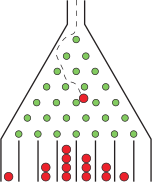
Also an LLM only produces output when it is prompted to do so.
Why is this a good measure of consciousness?
If continuity isn’t relevant for qualia, then LLMs could have perpetually incomplete perception like the edge of the image drawn on a CRT screen when captured at high frame rates. You never see a complete picture even if it’s technically represented.
It is certainly interesting to think about what your conscious experience would be like if it changed every brain cycle instead of being a continuous stream of information
This is strictly false, generalization in LLMs is well documented.
It’s also not relevant. Read the first point in the article: intelligence != consciousness. Individual ants, bats, and fish do not do anything very creative (certainly less creative than gpt-2), yet they are probably all conscious.
That’s not the reason, we’re in the same boat when it comes to knowledge in many ways.
But we don’t even know what consciousness is so it’s a waste of time reading the “3 reasons (*potential)” IMO.
Case in point have they ever turned on a model and left it for it to, on its own, decide “wait what’s going on, who am I, what/where am I?”. And start independently exploring?
Highly doubt it. If so, we’re cooked
I like this comment section